Travel Tips · 7 min read
Travelling With a Cat Without Losing Your Mind
A practical guide to making unfamiliar places and long journeys easier for your cat.
Cats are not small dogs, and travelling with one is a different discipline entirely. It is mostly about reducing change rather than adding excitement.
Dogs often enjoy the journey. Most cats simply want the journey to end. That is not a reason to avoid travelling with a cat — plenty of cats move house, cross borders and take long drives perfectly well — but it does shape how you prepare. The goal is a predictable, quiet, low-stimulation trip.
Start with an honest assessment
Some cats travel far better than others. Age, health, temperament and previous experience all matter. For a short holiday, a trusted sitter or cattery is sometimes genuinely kinder than a long journey. For a move or an extended stay, travelling together is usually the right call — and worth preparing for properly. If you are unsure, your veterinarian is the right person to ask.
Carrier training is the whole game
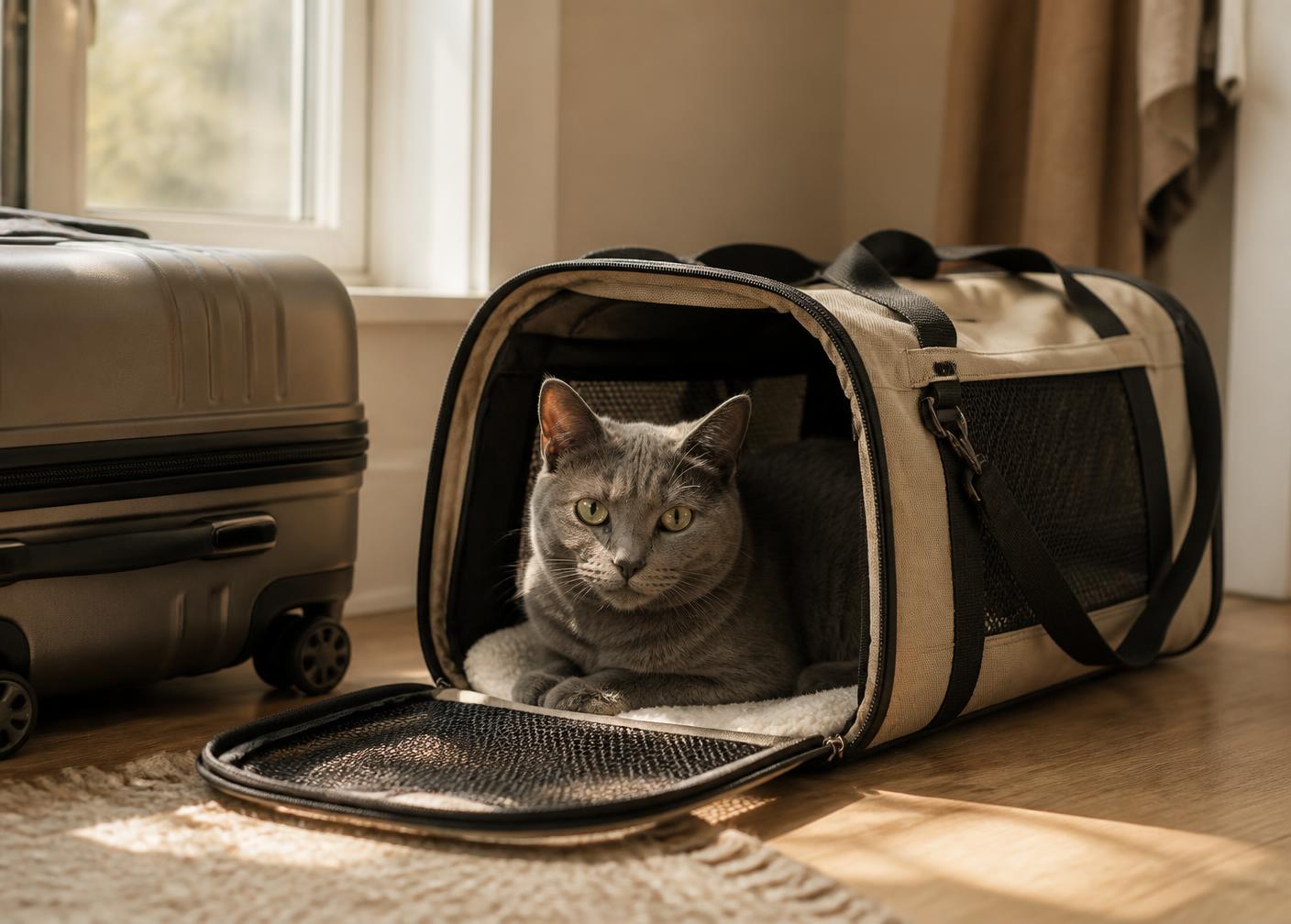
If the carrier only appears before vet visits, your cat has already learned what it means. Change that association weeks ahead.
- Leave the carrier out permanently as ordinary furniture.
- Put a familiar blanket and a few treats inside; feed meals near and then in it.
- Choose a hard-sided carrier that opens from the top as well as the front — it makes handling far easier.
- Practise short car journeys that end somewhere pleasant, like home.
Car journeys
Secure the carrier with a seat belt so it cannot slide or tip. Keep the cabin cool and the music low. Partially covering the carrier with a light cloth helps many cats by removing visual overload, while still allowing airflow.
- Do not open the carrier in a moving car, or at a rest stop without a secure enclosed space.
- Offer water during longer breaks; many cats will decline, which is normal.
- A small disposable litter tray is worth carrying on drives over a few hours.
- Never leave your cat in a parked car.
Flying
Cats usually travel in the cabin in an under-seat carrier where the airline allows it. Confirm carrier dimensions, fees, space availability and documentation requirements directly with the airline before booking, and speak to your veterinarian about whether your cat is a good candidate for air travel.
Arriving somewhere new
Do not open the carrier the moment you arrive. Set up one small, quiet, closable room first: litter tray in one corner, food and water in another, carrier open with a familiar blanket, and a hiding place such as a covered bed or a box on its side.
- Check the room for escape routes — open windows, gaps behind furniture, chimneys.
- Let your cat come out in their own time; do not tip them out or coax them.
- Keep feeding times and litter substrate the same as at home.
- Expand their access to the rest of the space gradually over a day or two.
Signs to take seriously
Refusing food for more than a day, not using the litter tray, hiding without any interest in surroundings, laboured breathing or any sudden change in behaviour all warrant contacting a local veterinarian. Look up the nearest clinic before you arrive, not while you are worried.
Travelling with a cat is quiet work. Done well, the highest compliment your cat can pay you is behaving, within a day or two, as though nothing much happened at all.